Elvis Death

The last photo of Elvis Presley taken at the gates of Graceland.

August 16, 1977.  The first person to see Elvis Presley dead was his fiancée Ginger Alden.  It had been six hours since she had last checked on him.  (Elvis former girlfriend Linda Thompson would not have let this happen.)   Elvis was found face down in front of the toilet.  Ginger assumed he had fallen into a drug-induced sleep.  Turning his head to see his purple face and his tongue caught between his teeth proved otherwise.

feelnumb.com on Tumblr: 39 Years Ago Today: Elvis Presley died in his upstairs bathroom at Graceland (FOLLOW LINK IN BIO TO SEE HIS BEDROOM & BATHROOM...

The head of Elvis’s security force Joe Esposito was called in.  Turning Elvis over, a gasp of air escaped.  Joe, too, wrongly thought his boss might still be alive.  The fact was Elvis had been dead for over two hours.  Rigor mortis had already set in.

An ambulance was called.  Joe tried CPR and mouth-to-mouth resuscitation.  The household staff became alert to the emergency.  Worst of all, so did Elvis’s daughter Lisa Marie who tried to run in the bathroom.  Ginger blocked her, locking the door.

The ambulance team was told by Elvis half-brother Rick Stanley that it might be an overdose.  (He should know.  He, along with Elvis’s dentist administered the fatal medications.)  It took five men to place Elvis on the gurney.  The King had ballooned to 255 pounds.

Elvis’s doctor, Dr. “Nick” Nichopoulos and Joe Esposito boarded the ambulance.  Ginger, who had finally made up her mind to go, had the back of the ambulance door shut in her face.

Dr. “Nick” feverishly worked at reviving the corpse that rocked the world.

Meanwhile, back at Graceland, Ginger consoled eight year old Lisa saying that her Daddy would be all right.  Others prayed.

Adrenalin was injected into the heart in a futile attempt to resurrect the fallen King.  An ambulance worker said it looked like Elvis was already dead.  These desperate attempts at life soon faded.  Elvis Presley – the King of Rock and Roll was pronounced dead from cardiac arrhythmia at 3:30 p.m.

The last jumpsuit that fit him – the Aztec sun design

PostScript

Col. Parker with Elvis

Col. Tom Parker would continue to manage Elvis’s legacy, collecting 75% instead of 50%.  This would continue until Lisa Marie reached maturity; whereupon, it was revealed that the Colonel had been scamming the Presley family for over thirty years.

Ginger Alden was shut out from the Presley family after appearing in an exploitation film titled “Living Legend:  The King of Rock and Roll”.  In 2014, she would write a book about their affair titled “Elvis and Ginger”.

Elvis with Ginger, Dec. 1976

Elvis’s father Vernon Presley, age 63, died two years later from a heart attack.

Elvis’s father

Lisa Marie Presley, age 54, would die from a bowel obstruction, the end result of bariatric surgery.

Elvis’s daughter

Benjamin Storm Presley Keough, Elvis’s only grandson would die at the age of 27 from suicide.  (Death by gunshot.)

Elvis’s grandson

Text © 2024 – EricReports

Elvis and “A Star is Born”

See the source image

The role that never was: Elvis in “A Star is Born”

Throughout the years, Elvis Presley was offered a variety of movie roles that were turned down by his manager, Col. Tom Parker.  These include:  The Rainmaker, Thunder Road, West Side Story, Bye-Bye Birdie, Walk on the Wild Side and Midnight Cowboy.

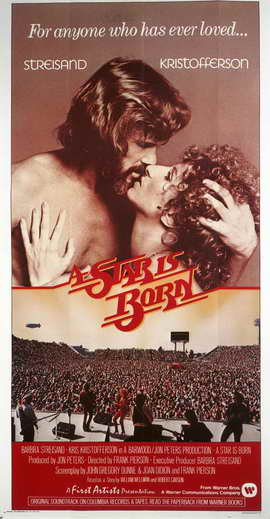
In 1975, Barbra Streisand and Jon Peters would offer the lead role of John Norman Howard in her remake of “A Star is Born”.  Elvis agreed to do it.  What happened?

Col. Tom Parker never wanted Elvis to outgrow him.  That is why he deliberately put him Grade-B musicals with Grade-B actors.  Maximum profit, low cost hamburger.

To kill the “Star is Born” deal, Col. Parker made outrageous demands…  $1 million upfront, $100,000 in expenses, star billing and the right to choose the songs and change the script.  The Colonel wanted all drug references removed.  He didn’t want Elvis’s character seen taking dope.  “The death of irony.”  The character of John Norman Howard is basically Elvis himself.  A mega-star whose career is on the decline because of drugs, booze and self-indulgence.  Just prop Elvis up in front of the cameras and let him be himself.  Did Elvis recognize this fact?

The producers offered the Colonel a percentage of the profits which would have made him and Elvis many millions of dollars.  Parker, of course, turned them down.

Image result for col. tom parker 1977

Elvis and the Colonel near the end.

Furthermore, the Parker would put it in Elvis’s head that Streisand-Peters went to him first (instead of the Colonel), to take advantage of him.  This played on Elvis’s worst fears, to be thought of as a “hillbilly rube”.  The Colonel had spent twenty years controlling “his boy”.  He knew how to push his buttons.  It’s especially sad considering the King was already forty years old.

Ego had everything to do with it.  Col. Tom Parker was offended beyond belief that Barbra Streisand would offer a movie deal to Elvis without consulting him.  This, above all else, destroyed it.

Streisand-Kristofferson sing “Evergreen”

Kris Kristofferson replaced Elvis.  The movie went on to be #2 at the box officer for 1976, winning an Oscar for “Best Song” (“Evergreen”) and Golden Globes for Kristofferson and Streisand.

See the source image

See the source image

Barbra Streisand accepts her Golden Globe. Paul Williams (co-winner) accepts for his work on the songs.

If the Colonel had been any kind of a manager, he would have encouraged, even forced, Elvis to do this role.  It would have presented the challenge he needed.  Instead, Elvis would return to his Howard Hughes-style of existence.  In those last two years, he did a few more records and a disastrous TV-special shown posthumously of a crumbling rock star who blew it.

See the source image

Elvis 1977

Text © 2022 – EricReports

ELVIS (2022)

Fascinating bio-pic of Elvis Presley as told from the point-of-view from his longtime manager Colonel Tom Parker.

Previously, we had the excellent TV-film “Elvis” (1979) as portrayed by Kurt Russell (Directed by John Carpenter.)  The difference between the two is the grim shadow Col. Parker hangs over Elvis’ career.

The movie is surprisingly accurate as to whom this illegal Dutch immigrant is:  a “carny” who learned to bluff and bamboozle everybody, eventually managing the most famous singer of the Twentieth Century.

Elvis himself was the first white singer who sang black – as shown by the various singers who influenced him.  Also, gospel.

The Colonel (played with sinister glee by Tom Hanks) doesn’t give a rat’s ass about the music.  He sees a walking money machine.

Elvis with parents

Gladys Presley, Elvis mother, rightly predicts:  “If Elvis signs with the Colonel, he’ll be dead by forty.”  But Elvis and his father Vernon sign their deal with the devil.

1956-1958.  The halcyon years where every song went gold, every movie became a hit, until he’s drafted in the Army.  Again, (a little known fact the movie gets right), Elvis is conned into joining the Army by the Colonel.  The plan is to clean up “El’s” image – make him a clean wholesome boy every mother would love.  The problem is:  you’ve just destroyed the rebel.

While in the Army, Gladys dies and the seed is sown for Elvis’ eventual self-destruction.  He never gets over it.

Olivia DeJonge as Priscilla Presley 💙💌 in 2022 | Elvis movies, Elvis presley movies, Elvis films

Olivia Dejonge as Priscilla

Soon after, he meets Priscilla Beaulieu, the fourteen year old Army brat, he’ll be forced to marry in 1967.

The 1960’s.  Elvis becomes a movie star doing three motion pictures per year.  The quality of these pictures declines in the mid-60’s and with the emergence of the Beatles – the King is temporarily dethroned.

1968.  NBC and TV director Steve Binder give Elvis a chance to save himself with a one hour TV special.  With nothing to lose, he takes it and it galvanizes “El” into a new and exciting phase in his career.  (Col. Tom will fight Elvis and Binder for control over this special; a rare time the Colonel will lose.)

1969.  Thus begins the Elvis Vegas show era that started off as a good thing until the grind drove Elvis to drugs.  Wife Priscilla gets fed-up with being left alone and files for divorce.  Again, this sets off a chain-reaction.  Elvis goes deeper and deeper into the world of narcotics.

1973.  Elvis’ last hurrah.  Because the Colonel can’t travel (no passport), he arranges a satellite special broadcast to 1.5 billion people.  It is a crowning achievement in the King’s career.

The final years.  With no more challenges, no more movies, Elvis is left alone with nothing except going on tour, more drugs, more girls, more bad food, turning him into what we now call the “fat Elvis”.

In a rage, Elvis finally fires the Colonel, who promptly turns around demanding $8 million for his expenses dating all the way back to 1956.  Elvis can’t pay, won’t file for bankruptcy and the two remain together until the bitter end.

Elvis concludes with “Unchained Melody” as sung in “Elvis in Concert”, his last TV special.

Post script.  The Colonel is sued by the estate of Elvis Presley (Priscilla and Lisa-Marie Presley) for misappropriation of funds – i.e., grabbing half and more of Elvis’ money.  It’s true again, as depicted in the film, Elvis was virtually enslaved by the International Hotel to perform for five years in exchange for paying off the Colonel’s gambling debt.  Not mentioned is how the Colonel sold off Elvis’ back catalog of RCA songs (1956-1973) squandering a fortune for a quick payoff.

Austin Butler as Elvis Presley.

Butler captures the charisma and the talent of the kid from Tupelo who would set the world on fire with his music.  He gets the many gestures and expressions, the quirks, the smiles and the anger that dominates the last years, succumbing into a dark cloud of depression.

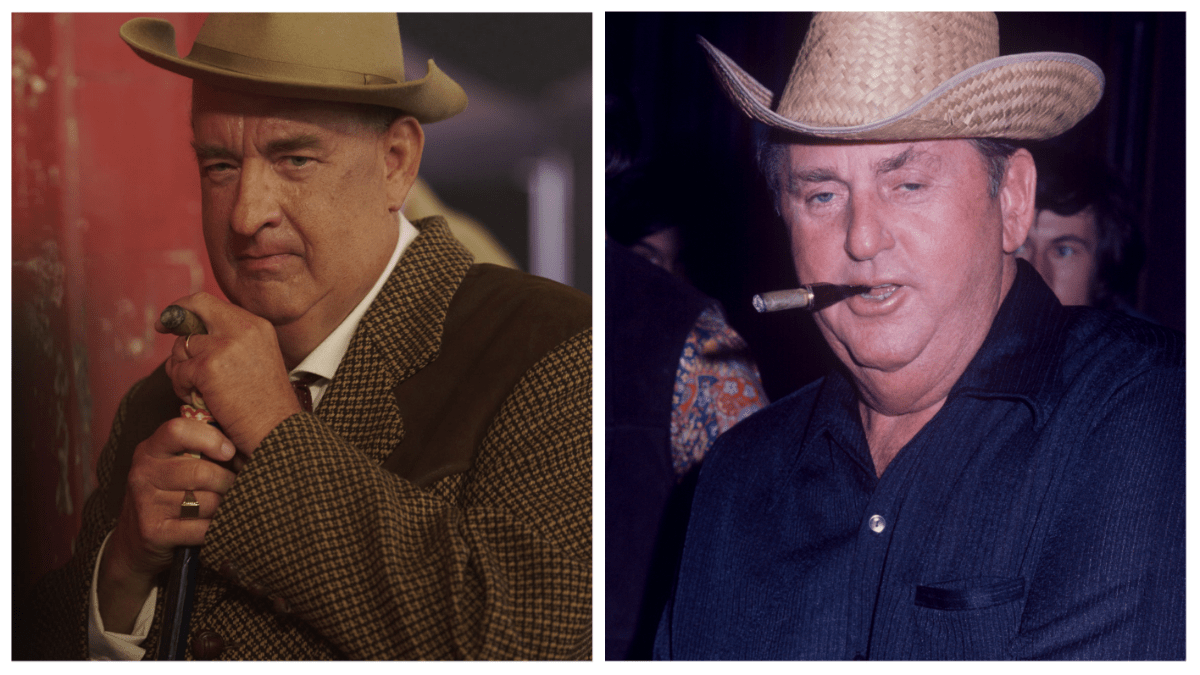
Tom Hanks as Col. Tom Parker. Hanks is on the left.  Parker is on the right.

Tom Hanks (an Elvis fan) wears a mountain of makeup and prosthetics, shapeshifting into the Colonel.  What Hanks gets right is the craftiness, the sly as a fox “snowman” as he is nicknamed.  (Wasn’t his whole life one big snow-job?)  What he doesn’t get right is the meanness.  The Colonel bullied others to get his own way using poor Elvis even after he died – selling his records repeatedly by repackaging them.  It is rumored the Colonel (aka Andreas Cornelis Van Kuijk) committed murder in his home country of Holland and then hopped a ship to the U.S. to avoid prosecution.)

Director-co-writer-producer-Baz Luhrmann

Baz Luhrmann pulls out all the stops making “Elvis” big, extravagant and over-the-top.  It’s what makes “Elvis” work.  You can’t get more to what the American dream is than Elvis and the unintended consequences.

Elvis fans may be disturbed by seeing the “King” turned into a pawn by the Colonel, but that’s the way it really was.  If it makes any difference, by 1977, Elvis was pretty much doing what he wanted – refusing to record (his last record is a patchwork of recordings from different years.)  And in the end, Elvis pulled the plug on himself, whether on purpose or by accident, he ended it his way.

Text © 2022 – EricReports

Elvis Movies – Best Vs. Worst

Elvis Presley appeared in thirty-three motion pictures during his lifetime – the first in 1956, the last in 1972.  Over the years, the quality of these has unfairly maligned.  Which are the best and which are the worst?

1956-1958 include four films including “Love Me Tender” and “Loving You.   The best were the last two being “Jailhouse Rock” and “King Creole”.

JAILHOUSE ROCK – Elvis plays a punk ex-con rocker who uses others for fame and glory.

KING CREOLE – A role inherited from James Dean.

After Elvis returned from the Army, Col. Tom Parker (Elvis’ manager) experimented with his image in various roles.  Ironically, the best of these (“Flaming Star” and “Wild in the Country’) made the least and the worst (“G.I. Blues” and “Blue Hawaii”) made the most.  Gone was the devil may care rebel replaced by the inoffensive, plastic, good guy schmuck.  During the early 1960’s, his success was pretty much hit or miss.

The best of the early 60’s output:  “Viva Las Vegas”, “Follow that Dream”, “Flaming Star” and “Wild in the Country”.

“Viva Las Vegas’ costarred sexpot Ann-Margret in their only film.  Sexual chemistry flew onscreen and off.

“Follow that Dream” – Elvis best comedy and probably his best acting performance.  Underrated.

“Flaming Star” – Western about a half-breed Indian.  Directed by Don Seigel.  A role originally intended for Marlon Brando.

“Wild in the Country” – Spicy melodrama has Elvis as a fledging writer romancing three women.  (Played by Hope Lange, Tuesday Weld and Millie Perkins.)

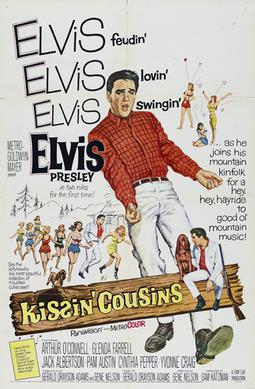
1964.  Col. Parker began lowering the budgets of the Elvis cash-cow productions, starting with “Kissin’ Cousins”.

Kiscousposter.jpg

“Kissin’ Cousins” made a lot of money and had a hit song, but cost Elvis his credibility.

This begat the formula Elvis pictures, usually three a year, where the King sang a lot, acted a little, beat-up the bad guys and kissed the girls.  From 1964 to 1968, the quality declined.  Some of the worst include “Easy Come, Easy Go” , “Harum Scarum”, “Paradise, Hawaiian Style”, “Spinout”, “Speedway”, “Double Trouble” and “Clambake”.

See the source image

Elvis worst song: “Yoga is as Yoga Does” from “Easy Come, Easy Go”

Live a Little Love a Little Poster.jpgSee the source image

One bright spot:  “Live a Little, Love a Little” (1968) which generated the hit song “A Little Less Conversation”.

1969.  An attempt at a comeback.  By this time, even the Colonel knew it was time for a change and made a request for better scripts.

“Charro” was meant to resemble the Clint Eastwood-Sergio Leone man-with-no-name Spaghetti westerns.  Somehow, it just didn’t work.  A copy of a copy.  No luck here.

“The Trouble with Girls (and how to get into it”) – A 1920’s period piece that goes nowhere.  Elvis looks good, sings better, yet there’s nothing solid.  Try again.

“Change of Habit” – Elvis plays a ghetto doctor who works with three undercover nuns.  Miscast Mary Tyler Moore can’t act dramatically, not yet anyway.  Seems like a TV movie.  Some good songs thrown in, including the posthumous hit “Rubberneckin'” (#2 album.)

THE DOCUMENTARIES  – “Elvis:  That’s the Way It Is” (1970) and “Elvis On Tour”(1972)

“Elvis:  That’s the Way It Is” catches “EL” in his second year at the Las Vegas International Hotel during rehearsal and the actual shows.  The 1970 cut has interviews of fans.  The 2001 cut removes these interviews for more songs.  Excellent soundtrack.  Highlights:  “Suspicious Minds”, “I Just Can’t Help Believin'”, “You’ve Lost that Lovin’ Feelin'” and many others.

“Elvis on Tour” (1972) would go on to win Best Documentary from the Foreign Press Association (known as the “Golden Globes”.)

“Elvis on Tour” is shown in split-screen images, some of which were edited by Martin Scorsese.  Contains part of a rare press conference.  The King, now separated from wife Priscilla, seems less happy, more self-involved and may be under the influence of “medications”.  Still, Elvis brings it.

Highlights include “An American Trilogy”, “Polk Salad Annie” and “Bridge Over Trouble Waters”.

See the source image

“Elvis on Tour” winner of the 1972 Golden Globe for Best Documentary.

“Elvis on Tour” is shown in split-screen images, some of which were edited by Martin Scorsese.  Contains part of a rare press conference.  The King, now separated from wife Priscilla, seems less happy, more self-involved and may be under the influence of “medications”.  Still, Elvis brings it.

Highlights include “An American Trilogy”, “Polk Salad Annie” and “Bridge Over Trouble Waters”.


Following Elvis’ death, there would be two films based on his life”  “Elvis” (1979) directed by John Carpenter and “This is Elvis” (1981) a documentary showing rare clips and recreations of his life.

See the source image

For the year 2022. a new theatrical film will be released titled “Elvis” directed by Baz Luhrmann, starring Austin Butler as the King.

Elvis 2022 poster.jpg

Text © 2022 – EricReports